Archive

synesthesia

I was home sick from work today, too sick to talk or really get out of bed and do anything– but fortunately not too sick to tap on a keyboard for a while. So I cracked open my long-neglected laptop and downloaded the latest version of Processing, which for those of you who don’t know it, is a really cool programming environment designed for artists. It’s a great big toybox full of fun gadgets, with plenty of examples to crib from, so you can just start with something interactive right away, and tinker with it until it does what you want–or does something completely unexpected.

It’s funny, because I was just talking with a friend the other day about watercolor, and how the happy accidents are what make that medium so much fun. We were comparing it to our day jobs in computer animation, where everything that happens is deliberate (not to mention expensive.) So it’s nice to see that happy accidents can happen in the computer once in a while too.

Neuroscientist Olympia Colizoli has done an interesting experiment where she tried inducing synaesthesia in non-synaesthetes:

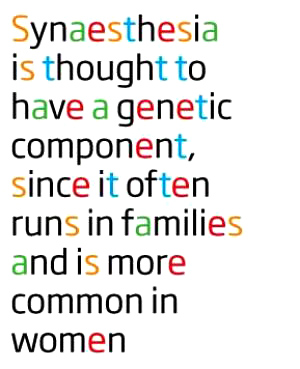
To test the idea, they gave seven volunteers a novel to read in which certain letters were always written in red, green, blue or orange (see picture). Before and after reading the book, the volunteers took a “synaesthetic crowding” test, in which they identified the middle letter of a grid of black letters which were quickly flashed onto a screen. Synaesthetes perform better on the test when a letter they experience in colour is the target letter.

The volunteers performed significantly better on this test after training compared with people who read the novel in black and white.

I’m curious as to how significant the effect turned out to be for non-synaesthetes. (I also wonder: what was the novel? Something by Nabokov maybe? ;-) Unfortunately I can’t find Colizoli’s data on line anywhere, as her research appears to have been presented as a conference poster session rather than a full publication. But hopefully we’ll be hearing more about this in the near future…

Update: You can read a more detailed abstract of Colizoli’s experiment over at synesthesia.info.

so many colors, so few of them right.

Digging through some old archives, I found this picture, which sums up one of the frustrating aspects of colored-letter synaesthesia. There are so many colored letters in the world, but to any synesthete, most of them will be wrong. I actually sorted through this entire bin of foam letters to pull out the ones that are colored correctly according to my synesthetic map. It’s the tiny pile on the right. Yes, that’s all of them.

For someone with colored-letter synesthesia, these kids’ toys are usually a frustrating thing to look at, because they generally get my colors completely wrong. So when I see one that gets more than a couple of letters even close to correct, I notice. This one nails the colors of B, P, S and Y, and is well within reason on M, R, and W. Given that orange and pink aren’t in this set’s pool of colors to choose from, even the E and the U are pretty close. Would I buy this set because of that? No, but it did make me stop and take a second look…

christianfaur_450

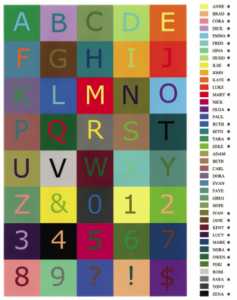
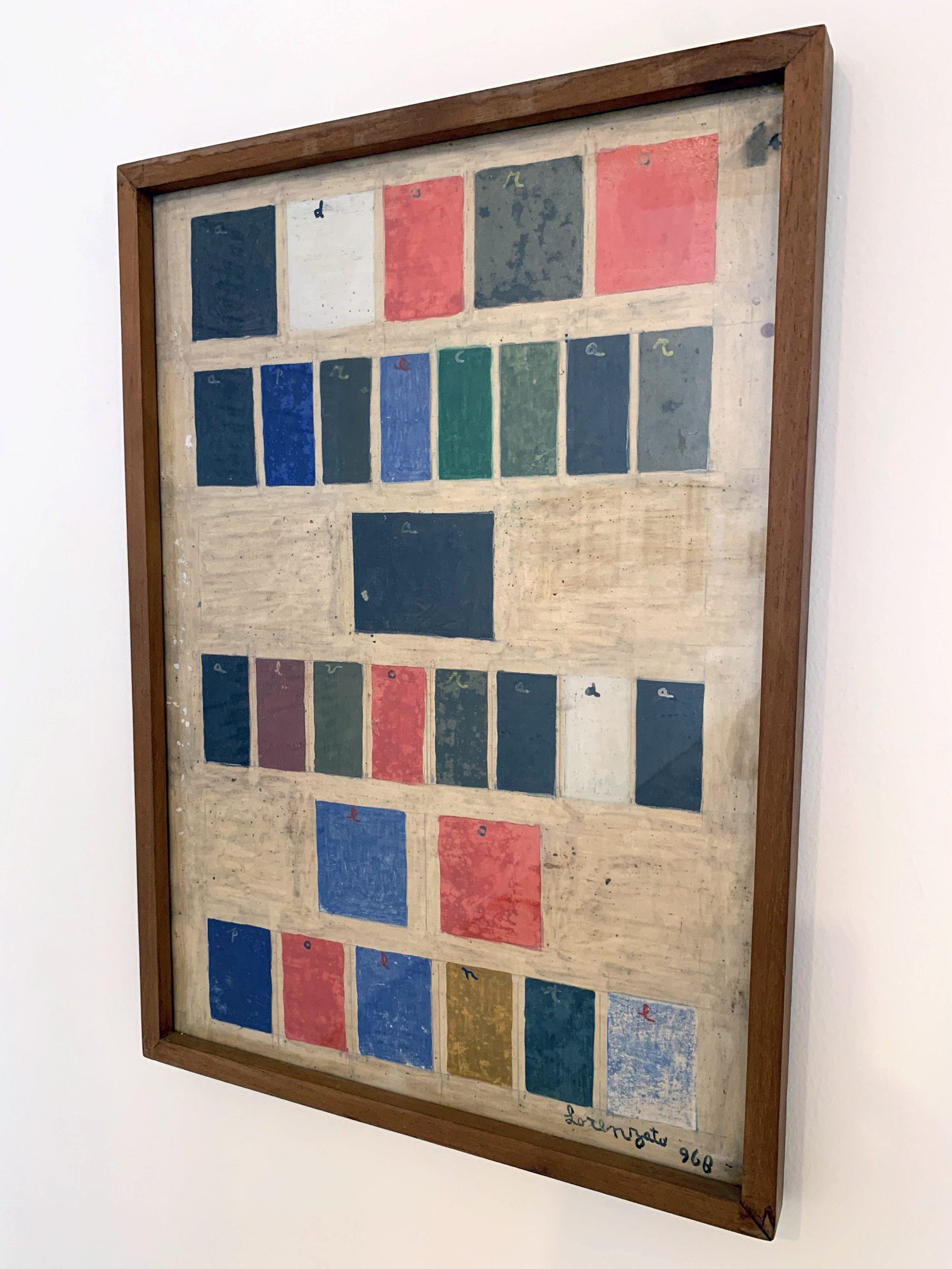
Christian Faur is an artist who makes these wonderful image-sculptures out of custom-cast crayons. The work itself is very Rungy Chungy and appealing to the eye. And Faur apparently has a thing for certain mathematicians. But it also turns out that he’s encoded synesthetic messages into several of his pieces:

Further, I have developed a mapping system that translates the English alphabet into twenty six discrete colors and I use these crayon “fonts” to add words and language to each of the pieces in the show… The direct representation of language in each piece further imbues the works with meaning and brings an aspect of color into each composition reminiscent of DNA coding. The alphabetic key at the lower left of each panel allows the viewer to interpret the individual words written throughout the various panels.

I gather that Faur does not actually have synesthesia himself, but this system makes perfect sense to me. If only he’d chosen his colors differently, I might be able to read the text straight up without the key! (Although it’s pleasing to note that his C, E, and Z are all perfect matches for my own.)

(via Drawn)


light_vowels_dark_consonants.jpg

Common Letters And Numbers Are Brighter, Study Suggests. Makes perfect sense to me!

I’ve always found it curious that the five highest-scoring Scrabble letters (K, J, Q, X and Z) all happen to be different shades of brown in my synesthetic map of the alphabet. Now there’s a new study by Daniel Smilek et al that suggests that this may be a pretty common phenomenon: “The More Common the Digit, the More Radiant the Color in Grapheme Color Synaesthesia”. How cool! This is the same Smilek who distinguished “projector” from “associator” synaesthetes in 2004.

(thanks to James for the link!)