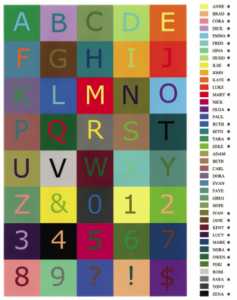
“Ivan is the colour of the letter G but four people saw it as Adam.”
I’m a big fan of color coding. I use it to help me wrap my head around complex tasks, like computer animation. I’m also a pretty harsh judge of color coding schemes, especially for transit systems. Growing up in New York spoiled me for good in that regard: the subway there has its flaws, but color is not one of them. Having synaesthesia also makes me tend to organize names by color in my head (but usually only in my head, since nobody else shares my personal alphabet of colors.)
One of the problems with any color coding scheme is that the more things you need to code, the harder it gets to choose distinct colors. But where exactly is the limit? That’s the subject of this interesting paper, A Colour Alphabet and the Limits of Colour Coding(PDF) by Paul Green-Armytage. The lengths these folks went to to understand the problem are impressive. The paper also has great sentences like “Ivan is the colour of the letter G but four people saw it as Adam.” (Thanks to Mike K. for the link!)
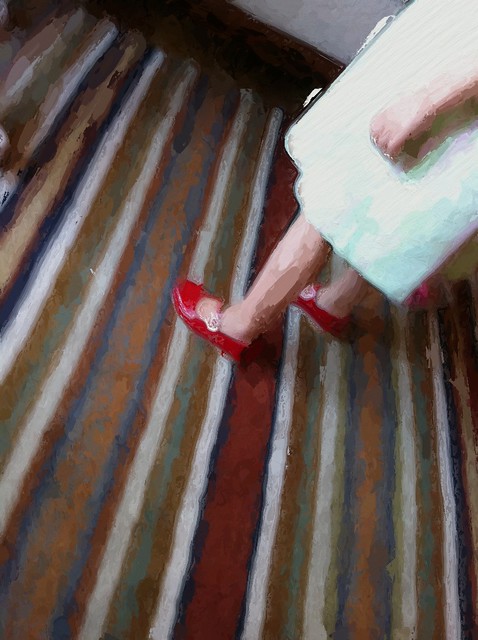
My friends Dan Wexler and Gilles Dezeustre have just released a new app for your iPhone/iPad. It’s called Glaze. It’s a painterly rendering filter for your photos, and it’s really cool. It’s based on the traditional brushstroke-based model pioneered by folks like Paul Haeberli, Pete Litwinowicz and Aaron Hertzmann, but it adds some neat new twists: face detection to guarantee that eyes and other important features come out with the right amount of detail; a genetic algorithm for mutating and doing artificial selection on painting styles; and a really slick iOS interface that makes all of the above completely effortless and transparent. It also runs blazingly fast, considering all the work that must be going on under the hood. They’ll be giving a talk about the details at SIGGRAPH next week. (Here’s an abstract of their talk… wish I could go!)
What I find the app does best, so far, is to turn my garbage photos into beautiful art. This, for example, is a picture my thumb took by accident as I was putting away my phone. The original photo was blurry, out of focus, and weirdly composed. But the painting’s handmade feeling makes your eye linger on the details, and the results are just lovely. (Everyone’s Instagram is about to get a lot prettier!)
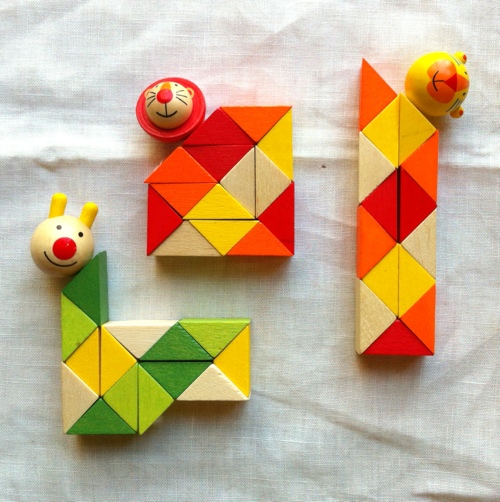
Our friends in São Paulo gave our daughter these cute wooden folding toys. They’ve got elastic running through the middle, so you can twist the pieces around and make different shapes. After playing with them for a while, I noticed that they have an interesting mathematical property: when folded into any flat shape, any two triangles that meet are always the same color, forming a grid of diamonds (or squares, depending on your point of view.) I can’t help wondering why this is. It has something to do with the repeating pattern of four colors, obviously, but what?
Cassidy Curtis's splendid display of colorful things.