The New Chair, rough cut (1998) from Cassidy Curtis on Vimeo.
Here’s a rough cut of part of a short film I started while working at the University of Washington. I did all the animation, and developed the Loose and Sketchy rendering style.
The character animation is pretty janky overall, though a few of the shots hold up pretty well. I sure have learned a lot since 1998!
MTV Top 20 Video Countdown (1994) from Cassidy Curtis on Vimeo.
In the 1990’s, it was typical for production companies to start their demo reels with a clock-wipe countdown. Some companies would use this as an opportunity to say something about their style, and do custom animation. (Will Vinton Studios, I remember, had a particularly cool stop-motion countdown at that time.) I thought it would be cool for Xaos to have a countdown that reflected our particular style of work, so I created this drippy ink effect counting down from 10 to 1, and a drippy version of the Xaos logo, which we put at the beginning and end of our demo reel respectively.
Some time after this, our producer got a call from MTV. They had this show called “Top 20 Video Countdown”. They wanted to use this effect for the bumpers and interstitials. Could we add the numbers 11 through 20? Our producer said “of course”, and charged them a lot of money. But it didn’t really take me that long.
Brick-a-Brac (1995) from Cassidy Curtis on Vimeo.
Here is my first short film. I made this at PDI in 1995, during a gap between commercials. I modeled and rigged the characters, did most of the animation, and developed the wobbly ink-line look.
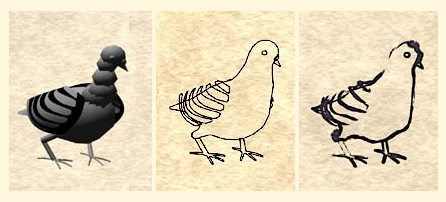
The pigeons’ torso was a metaball surface driven by a series of spheres along a spline between the head and the body, which were both separate IK joints (so I could easily get that pigeon-head movement style without counteranimating.) The eyes, beak, legs and wings were separate objects, each of which got rendered in its own separate pass. Each layer had its vector outline traced (using a tool originally written for scanning corporate photostats for flying logos!) I processed the curves using a procedural scripting language to give them some physics and personality, and then rendered them as black ink lines with varying thickness (using a tool written by Drew Olbrich). Finally, I ran the rendered lines through some image processing filters to get the edge darkening effect, and did some iterated stochastic silhouette dilation to add random ink blotches where the lines were thickest. Simple, really! ;-)
Cassidy Curtis's splendid display of colorful things.
